Bronze Rods & Bars
Phosphor Bronze Rod — C52100
A high-tin wrought phosphor bronze offering greater hardness, strength and wear resistance than C51000 or C51900.
Product overview
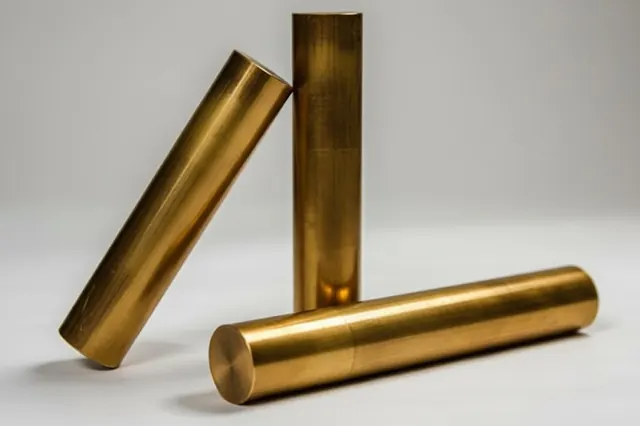
C52100 rod suits sliding and load-bearing turned parts. As the alloy is hard, state the finished part geometry so the company can advise on practical machining stock.
C52100 contains about 8% tin, the highest tin level among the common wrought phosphor bronzes. The result is a harder, stronger alloy with excellent fatigue behaviour and good wear resistance, at the expense of cold formability.
It is typically chosen for parts that see sliding contact, load cycling or elastic deflection and where the extra hardness is worth the reduced bendability – for example heavy-duty springs, wear plates and certain bushings.
Material identification
| Item | Detail |
|---|---|
| UNS designation | C52100 |
| Material | Phosphor Bronze C (8% Tin) |
| Alloy family | Phosphor Bronze |
| Alloy type | Wrought copper-tin-phosphorus alloy |
| Product form | Rod / Bar |
| Availability | Listed – sizes, tolerances and stock confirmed per inquiry |
Where it is used
- Heavy-duty springs and diaphragms
- Wear plates and sliding components
- Bushings and bearing parts for demanding duty
- Gears and worm-wheel type components (design dependent)
- Marine and chemical hardware in compatible service
Machining and fabrication
Considered a harder, slower-machining alloy than C51000. Bending and severe forming require care, particularly in higher tempers. Brazing and soldering are practised.
Forms and sizes
- Round rod / bar (solid)
- Hollow bar / tube blanks – subject to confirmation
- Square, hexagonal and flat bar – subject to confirmation
- Cut lengths and machined blanks – subject to confirmation
Available diameters, lengths, tolerances and tempers are not listed on this website and are confirmed per inquiry. Do not rely on this page for dimensions, tolerances or stock.
What to include in your inquiry
- UNS grade and governing specification
- Dimensions (or drawing) and tolerance class
- Quantity and delivery timing
- Application and operating environment
- Certificate / inspection requirements
Composition reference
| Element | Nominal limit, wt % |
|---|---|
| Copper (Cu) | Remainder |
| Tin (Sn) | 7.0 – 9.0 |
| Phosphorus (P) | 0.03 – 0.35 |
| Zinc (Zn) | 0.20 max |
| Iron (Fe) | 0.10 max |
| Lead (Pb) | 0.05 max |
Reference data only – typical or nominal values from published specifications, not a guarantee of supplied material. Confirm against the current edition of the applicable specification, the product form and condition, and the material test certificate. Technical review by the company is required before publication or reliance.
Commonly referenced specifications
- ASTM B139/B139M – rod, bar and shapes
- ASTM B103/B103M – plate, sheet, strip and rolled bar
- Alloy and product-form coverage to be confirmed against the current edition
Related grades
Frequently asked questions
Is C52100 stronger than C51000?
In general, the higher tin content gives higher hardness and strength for a given temper, with lower formability. Actual values depend on the specification and temper.
Can C52100 be bent?
Limited bending is possible, but severe forming is better done in softer tempers or with C51000.
Looking for C52100 rod?
Share your dimensions, quantity and documentation needs with our team.