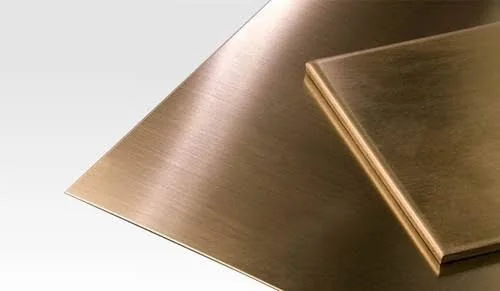
Bronze Plates & Sheets
Phosphor Bronze Plate — C51900
A phosphor bronze with a higher tin range than C51000, selected for greater strength and wear resistance in bushings, fasteners and spring parts.
Product overview
C51900 plate and sheet are requested for formed and stamped parts needing more strength than C51000. Product-form availability, gauge and temper are confirmed per inquiry.
C51900 sits between the common 5% (C51000) and 8% (C52100) phosphor bronzes. The additional tin gives higher strength and better resistance to wear and fatigue than C51000, while retaining reasonable cold-working behaviour in strip and sheet forms.
It is an option for engineers who find C51000 slightly too soft for a bearing or wear application but do not need the hardness or reduced formability of C52100. As with every grade on this site, suitability depends on the temper, product form and operating conditions.
Material identification
| Item | Detail |
|---|---|
| UNS designation | C51900 |
| Material | Phosphor Bronze (6% Tin) |
| Alloy family | Phosphor Bronze |
| Alloy type | Wrought copper-tin-phosphorus alloy |
| Product form | Plate / Sheet |
| Availability | Listed – sizes, tolerances and stock confirmed per inquiry |
Where it is used
- Bushings and sleeves under moderate load
- Fasteners and washers
- Spring components and flexible parts
- Wear strips and guides
- General engineering turned parts
Machining and fabrication
Machinable with suitable tooling and parameters but not a free-cutting grade; the harder tempers machine more slowly. Soldering and brazing are practised. Welding should be reviewed case by case.
Forms and sizes
- Plate (thicker flat product)
- Sheet and strip (thinner gauges) – subject to confirmation
- Cut-to-size and machined plates – subject to confirmation
- Discs and circular blanks – subject to confirmation
Plate and sheet terminology varies by standard and region. State the thickness, width, length and tolerance you need rather than relying on a label. Do not rely on this page for dimensions, tolerances or stock.
What to include in your inquiry
- UNS grade and governing specification
- Dimensions (or drawing) and tolerance class
- Quantity and delivery timing
- Application and operating environment
- Certificate / inspection requirements
Composition reference
| Element | Nominal limit, wt % |
|---|---|
| Copper (Cu) | Remainder |
| Tin (Sn) | 5.0 – 7.0 |
| Phosphorus (P) | 0.03 – 0.35 |
| Zinc (Zn) | 0.30 max |
| Iron (Fe) | 0.10 max |
| Lead (Pb) | 0.05 max |
Reference data only – typical or nominal values from published specifications, not a guarantee of supplied material. Confirm against the current edition of the applicable specification, the product form and condition, and the material test certificate. Technical review by the company is required before publication or reliance.
Commonly referenced specifications
- Applicable ASTM / customer specification and product-form coverage to be confirmed before publication or ordering
Related grades
Frequently asked questions
When would I choose C51900 over C51000?
When the application needs more strength or wear resistance than the 5% tin grade provides and the part is not severely formed after hardening.
Is C51900 available as plate?
Plate and sheet are listed on this site; exact availability, thickness range and temper are confirmed with the company for each inquiry.
Looking for C51900 plate?
Share your dimensions, quantity and documentation needs with our team.