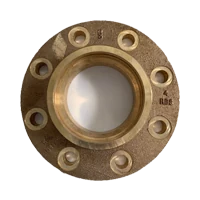
Bronze Flanges
C51000 Phosphor Bronze Flanges
A general-purpose wrought phosphor bronze with about 5% tin, valued for its combination of strength, fatigue resistance, formability and corrosion resistance.
Special-order / application-specific. Please confirm with the company before specifying this product form.
Product overview
Phosphor bronze flanges are not a standard cast flange material. C51000 flanges would be machined from wrought stock and are treated as a special-order, application-specific item.
C51000 is the most widely specified of the wrought phosphor bronzes. Tin strengthens the copper matrix and a small residual phosphorus content (retained from deoxidation) improves strength and wear behaviour. It is commonly supplied as rod, bar, plate, sheet and strip, and can be cold worked to higher strength tempers.
Compared with higher-tin phosphor bronzes such as C52100, C51000 offers better cold formability and bendability, while giving up some hardness and wear resistance. Compared with the free-cutting grade C54400, it is not leaded, so it is normally selected where formability, spring behaviour or lead-free composition matter more than high-speed machining.
Material identification
| Item | Detail |
|---|---|
| UNS designation | C51000 |
| Material | Phosphor Bronze A (5% Tin) |
| Alloy family | Phosphor Bronze |
| Alloy type | Wrought copper-tin-phosphorus alloy |
| Product form | Flanges |
| Availability | Special-order / application-specific |
Where it is used
- Springs and spring-type components
- Electrical contacts and connectors (as strip/sheet)
- Fasteners, clips and washers
- Diaphragms and flexible elements
- Bushings and wear parts for light to moderate duty
- Chemical and process hardware in compatible environments
Machining and fabrication
Machinable, but not a free-cutting alloy – expect lower machining rates than leaded grades such as C54400. Cold forming and bending are among its strengths. Joining by soldering and brazing is practised; welding is not typical and should be reviewed for the application.
Forms and sizes
- Cast or machined flanges to drawing or standard – subject to confirmation
- Blind, slip-on, threaded and similar types – subject to confirmation
- Special-order flanges from wrought stock (e.g. C51000)
Standards, sizes, facings and ratings are confirmed with the company for each inquiry; none are published here. Do not rely on this page for dimensions, tolerances or stock.
What to include in your inquiry
- UNS grade and governing specification
- Dimensions (or drawing) and tolerance class
- Quantity and delivery timing
- Application and operating environment
- Certificate / inspection requirements
Composition reference
| Element | Nominal limit, wt % |
|---|---|
| Copper (Cu) | Remainder |
| Tin (Sn) | 4.2 – 5.8 |
| Phosphorus (P) | 0.03 – 0.35 |
| Zinc (Zn) | 0.30 max |
| Iron (Fe) | 0.10 max |
| Lead (Pb) | 0.05 max |
Reference data only – typical or nominal values from published specifications, not a guarantee of supplied material. Confirm against the current edition of the applicable specification, the product form and condition, and the material test certificate. Technical review by the company is required before publication or reliance.
Commonly referenced specifications
- ASTM B139/B139M – phosphor bronze rod, bar and shapes
- ASTM B103/B103M – phosphor bronze plate, sheet, strip and rolled bar
- Alloy and product-form coverage to be confirmed against the current edition before specifying
Related grades
Frequently asked questions
Is C51000 the same as C51900?
No. Both are tin-phosphorus bronzes, but C51900 has a higher nominal tin range, which generally increases strength and wear resistance and reduces formability.
Is C51000 free-cutting?
No. It is not a leaded alloy. If high-speed machining is the priority, C54400 is the usual phosphor bronze to consider.
Can I get a material test certificate?
Documentation options depend on the order and are confirmed by the company. State your requirement (for example EN 10204 type) on the inquiry.
Looking for C51000 flange?
Share your dimensions, quantity and documentation needs with our team.